Article Summary
Pole fielding estimates are built around a “poles per day” average that assumes accessible poles, manageable terrain, and cooperative property owners. None of those things are guaranteed. Rear-yard access issues, steep or overgrown terrain, and field hazards like poison ivy are predictable realities on most projects — and when time pressure causes crews to rush through them, measurement accuracy suffers. Small field data errors can cause poles to fail structural analysis when they shouldn’t, triggering unnecessary replacements that run $3,000 to $10,000 or more. Accurate fielding requires realistic schedules and measurement discipline that holds even when conditions make the work hard.
_____________________
There’s a number that appears on almost every pole fielding estimate: poles per day. It’s how crews get scoped, how timelines get built, and how budgets get approved. The problem is that number assumes a lot — mostly that poles are accessible, that the terrain is manageable, and that the people who own the property around them are cooperative and home.
In practice, none of those things are guaranteed.
Experienced field crews know what project managers working from a spreadsheet often don’t: the time it takes to field a pole varies enormously depending on conditions that can’t be seen from a map. Some of those conditions are annoying. Some of them are expensive. All of them affect whether your project data comes back accurate and complete, or whether someone has to go back out.
Here’s what actually slows field work down — and why it matters to the project downstream.
The homeowner who isn’t home
A meaningful percentage of utility poles sit in rear yards, behind fences, and on private property. To reach them, a field crew needs access. That means either catching the homeowner at the right time or scheduling a return visit. Neither option is quick.
Sometimes the homeowner isn’t home. Sometimes they’re home but decline to grant access. Either way, the pole doesn’t get fielded that day, and someone has to go back. That revisit isn’t built into the original estimate. The time cost is real, and it compounds across a project if a significant portion of poles are in similar situations.
Click to view video:
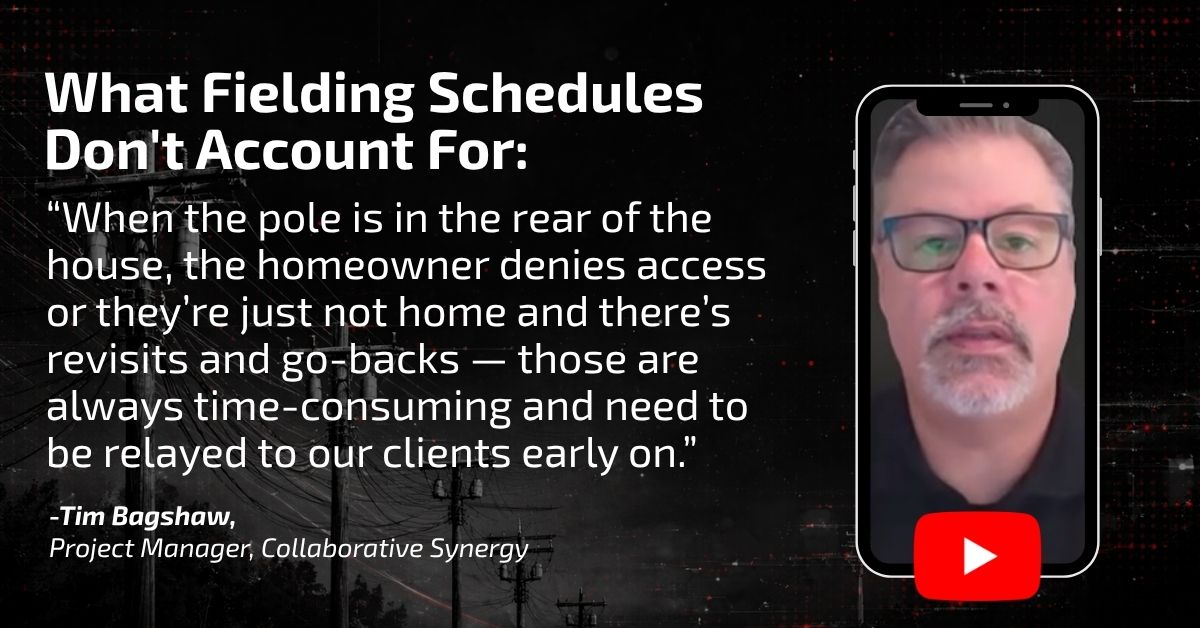
This isn’t unusual. On any project that runs through residential areas, rear-yard and limited-access poles are a predictable part of the work. Tim Bagshaw, Project Manager at Collaborative Synergy, accounts for access challenges and communicates field realities to his clients early and often: “When the pole is in the rear of the house, the homeowner denies access or they’re just not home and there’s revisits and go-backs — those are always time-consuming and need to be relayed to our clients early on.” The question is whether your fielding team has the experience to flag those situations early, communicate proactively, and plan around them — or whether you find out about them when the schedule slips.
Terrain that’s hard to get to on foot
Utility infrastructure doesn’t always follow roads. In rural areas especially, pole lines often take the most direct path between two points, which means cutting across terrain that isn’t accessible by vehicle and may be difficult to reach on foot.
Steep elevation changes are physically demanding and slow down even experienced field crews. Dense or overgrown vegetation slows progress further and sometimes requires clearing the path before you can even see the pole. In some cases, a pole that should take twenty minutes to document takes two hours because of what’s between the truck and the base of the pole.
This kind of terrain also wears on people. “Those are the items that can take up a lot more of your time and effort,” Bagshaw says. “Especially when there’s a big change in elevations — that wears on the person who’s out there with boots on the ground.” A crew that has fought through steep, overgrown ground isn’t operating at the same level of precision they were at 7 a.m. Experienced field supervision accounts for this. Schedules built on per-day averages often don’t.
Conditions that require a full stop
Some situations can’t be worked around — they require a crew to stop, back off, and return with different equipment or protective gear.
Poison ivy and poison oak are the most common examples. A pole surrounded by either requires proper personal protective equipment (PPE) before anyone gets close enough to do the measurement work. If a crew doesn’t have that gear on-site, the pole doesn’t get fielded that day. Coming back prepared means another trip, more coordination, and more time that wasn’t in the original plan.
These aren’t unusual situations. They’re recurring field realities that come with the territory of working in rural, semi-rural, and residential environments. As Bagshaw puts it: “You can run into instances where there’s poison ivy or poison oak all around the pole and you need to change your tactics — usually go back to it because now you need proper PPE to make sure you’re not going to get infected.”
Why this connects directly to data quality
Fielding delays are frustrating on their own. But the more significant problem is what happens when time pressure causes field crews to cut corners or work too quickly on difficult conditions.
Pole loading analysis is only as accurate as the data that goes into it. Small measurements matter more than most people expect. The difference between a 6M and a 10M down guy — the diameter of the shank, the sizing of the anchor — can be the difference between a pole that passes structural analysis and one that’s flagged for replacement. A pole replacement runs $3,000 to $10,000 or more. On a project with hundreds or thousands of poles, inaccurate field data isn’t just a rounding error, it’s a capital expenditure problem.
That accuracy has to be built into how the work gets done in the field, not corrected for after the fact in the engineering model. “Accuracy at the pole is very important for the entire life of the whole project,” Bagshaw says. “If you model the pole with a smaller down guy and a smaller anchor because there was inaccurate field data, that’s going to potentially cause the pole to fail when it’s not really failing in its current state.”
What this means for your project
None of these issues are insurmountable. Experienced field teams build them into how they plan and execute work, identifying likely access challenges before showing up, communicating early when conditions require a return trip, and maintaining measurement discipline even when terrain makes the work harder.
What they can’t do is eliminate time that wasn’t accounted for in the first place. Projects scoped on optimistic daily averages tend to run behind, produce rushed field data, or both.
Accurate fielding takes the time it takes. The goal is to have the right people doing it, with the experience to handle what they find — and enough margin in the schedule to do it right.
If you’re scoping a fiber build and want fielding support that accounts for what the schedule doesn’t, talk to our team. We work with ISPs and broadband providers nationwide on pole fielding, make-ready engineering, and attachment applications.
__________________________
Frequently Asked Questions
What does “poles per day” mean in a fielding estimate, and why is it often misleading? Poles per day is the standard unit used to scope field crews, build timelines, and set budgets. It’s a useful shorthand, but it’s based on an average that assumes consistent access and manageable conditions. When poles are in rear yards, behind fences, on steep terrain, or surrounded by hazards, time per pole increases significantly — and those situations are common enough on most projects to materially affect schedule.
What happens when a homeowner won’t grant access to a rear-yard pole? The pole doesn’t get fielded that day. The crew has to document the attempt and schedule a return visit, which adds time and cost that typically aren’t built into the original estimate. On a project with a significant share of rear-yard poles, those go-backs compound into real schedule impact.
How does difficult terrain affect fielding quality, not just speed? Physically demanding conditions — steep slopes, overgrown vegetation, poor footing — wear on crews over the course of a day. A fielder who has been fighting terrain for several hours is more likely to make small measurement errors than one who is fresh. Those errors may seem minor in the field but have significant consequences when the data is run through pole loading software.
Why do small measurement errors in fielding matter so much? Pole loading analysis is only as accurate as the data that feeds it. The difference between a ¾-inch and a 1-inch anchor shank, or two to three inches in ground line circumference, can determine whether a pole passes or fails structural analysis. A pole flagged incorrectly for replacement costs $3,000 to $10,000 or more to address. On large projects, inaccurate fielding data is a capital expenditure problem.
What should ISPs look for in a pole fielding partner? Experience handling real-world access and terrain challenges, proactive communication when conditions require a return trip, and disciplined measurement practices that don’t slip when the work gets physically difficult. The goal is field data accurate enough that the engineering that follows it doesn’t require refielding — because refielding is expensive and delays the entire project. Get in touch to discuss your project’s permitting readiness.
